Retrace!
The ocean at the heart of your educational projects
Turn education on sustainable development into a hands-on experience!The RETRACE! program’s cleanups offer an innovative educational approach that is perfectly aligned with ESD (Education for Sustainable Development) principles.
The Retrace! program’s cleanups offer an innovative educational approach that is fully aligned with ESD guidelines. All you need to do is create a school account to get started and access all the available educational resources.
An enriching experience that goes beyond the classroom walls and connects your students to the major environmental challenges of our time.
A ready-to-use educational program for your students
Retrace! offers a comprehensive educational program that can be easily integrated into your curriculum and is aligned with school standards. This engaging approach allows your students to learn by taking concrete action to protect the environment.
Our goal: to use cleanup as an enriched learning tool.
The ready-to-use educational resources we provide will help you enrich your lessons and go far beyond simple cleanup.
Your students will discover scientific methods and understand the usefulness of participatory science in environmental research.
Every piece of data collected by your students is meaningful: it first helps to better understand pollution at the local level, thenis integrated into a European database that can be used tochallenge decision-makers and bring about regulatory change.
How does it work?
We have developed programs specifically tailored to the age group of your students, for an optimal educational experience.
Elementary & Middle Schools: The Young Detectives Investigation
A real-world field investigation that turns your students into detectives!
This immersive approach takes your classes on a journey to discover the coastline or waterway near their school, exploring nature and gaining a practical understanding of the challenges associated with water pollution.
How did this trash get there? Where does it come from? What impact does it have on wildlife?
These are just some of the questions your young investigators will solve.
Through a rigorous scientific protocol built around the captivating world of police investigations, students take on the role of real-life environmental detectives.
This fun and educational method allows them to actively participate in collecting scientific data on aquatic waste:
Identification and recognition of the study site
Students learn to observe their environment and carry out a detailed survey of the chosen site.
Field assignment
Equipped like real detectives, they set out to investigate and meticulously collect all clues of potential pollution during a private cleanup.
Analytical laboratory
Back in the classroom, all the evidence collected is carefully sorted, analyzed, and quantified using a method
and highly visual tools specially designed for their age group.
Compiling the file
All evidence is recorded in the national evidence database, a scientific database that must be completed and returned to us so that the data can be used by researchers.
This approach enables students to gain a concrete understanding
of the usefulness of participatory science and its contribution to environmental research.
High schools: From observation to civic action
This is an ambitious project, co-developed with the IRD (French National Research Institute for Sustainable Development), that teachers can carry out entirely on their own.
The goal is twofold: to introduce your high school students to a rigorous scientific approach while actively raising their awareness of ocean conservation.
This innovative program takes students on a field trip to observe pollution in the area surrounding their school, with the aim of introducing them to local advocacy initiatives.
The key idea is to give them the tools they need to make a real difference in their local community.
The program is spread out over the school year through a coherent series of sessions that follow a logical progression:
Observation phase
Methodical field survey to identify and document pollution in the environment surrounding the facility
Scientific analysis phase
Rigorous processing of data collected according to validated scientific protocols, development of critical thinking and interpretation skills
Analytical laboratory
Structured formulation of requests and demands based on observations, preparation of advocacy actions to engage local stakeholders (local authorities, businesses, associations)
This comprehensive approach empowers your high school students to become true agents of change: they learn to turn their scientific observations into concrete ways to take action in their local communities, thereby developing their sense of civic responsibility and their ability to take initiative.
Project currently in development

For elementary and middle schools
Elementary & Middle Schools: The Young Detectives Investigation
A real-life field investigation that turns your students into detectives!
This immersive approach takes your classes on a journey to discover the coastline or waterway near their school, exploring nature and gaining a practical understanding of the challenges associated with water pollution.
How did this trash end up there? Where does it come from? What impact does it have on flora and fauna? These are all questions your young investigators will solve.
Through a rigorous scientific protocol built around the captivating world of police investigations, students take on the role of real-life environmental detectives.
This fun and educational method allows them to actively participate in collecting scientific data
on aquatic waste:
Identification and recognition of the study site
Students learn to observe their environment and carry out a detailed survey of the chosen site.
Field assignment
Equipped like real detectives, they set out to investigate and meticulously collect all clues of potential pollution.
Analytical laboratory
Back in the classroom, all the evidence collected is carefully sorted, analyzed, and quantified using a method
and highly visual tools specially designed for their age group.
Compiling the file
All evidence is recorded in the national evidence database, a scientific database that must be completed and returned to us so that the data can be used by researchers.
This approach enables students to gain a concrete understanding
of the usefulness of participatory science and its contribution to environmental research.
For high schools
High schools: From observation to civic action
This is an ambitious project co-developed with the IRD (French National Research Institute for Sustainable Development), which teachers can carry out entirely on their own.
The goal is twofold: to introduce your high school students to a rigorous scientific approach while actively raising their awareness of ocean conservation.
This innovative program takes students on a field trip to observe pollution in the area surrounding their school, with the aim of introducing them to local advocacy initiatives. The key idea is to give them the tools they need to make a real difference in their local community.
The program is spread out over the school year through a coherent series of sessions that follow a logical progression:
Observation phase
Methodical field survey to identify and document pollution in the environment surrounding the facility
Scientific analysis phase
Rigorous processing of data collected according to validated scientific protocols, development of critical thinking and interpretation skills
Analytical laboratory
Structured formulation of requests and demands based on observations, preparation of advocacy actions to engage local stakeholders (local authorities, businesses, associations)
This comprehensive approach empowers your high school students to become true agents of change: they learn to turn their scientific observations into concrete ways to take action in their local communities, thereby developing their sense of civic responsibility and their ability to take initiative.
For universities
Project currently in development
The organizer's kit
The items listed right here are the essentials for a successful cleanup!
And the good news is that as soon as your cleanup is registered,
the kit is shipped as quickly as possible* so it’ll be ready on the big day.
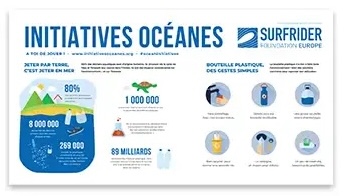
An educational banner
It will help you raise awareness by providing key data on aquatic waste and examples of simple actions you can take to rethink your use of plastic bottles.
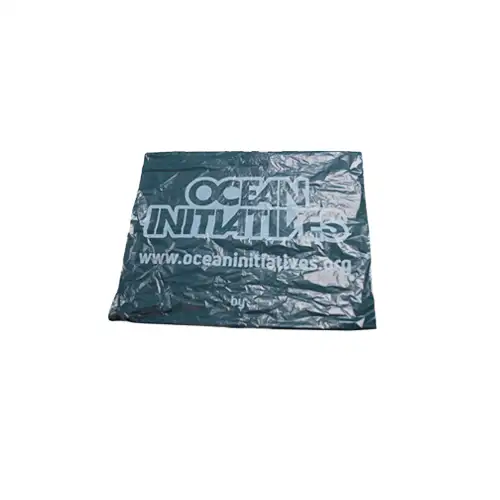
plastic bags
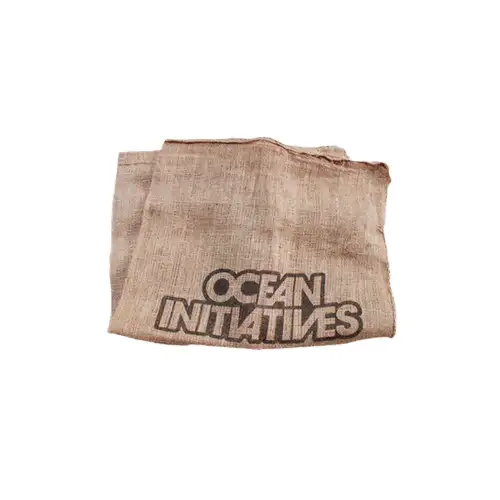
jute bags
Jute bags, which are more durable than plastic bags and can be reused, can also come in handy. We suggest using them to separate certain types of waste (glass, metal, and others). Be sure to collect these bags at the end of the cleanup, rinse them out, and let them dry so you can reuse them.
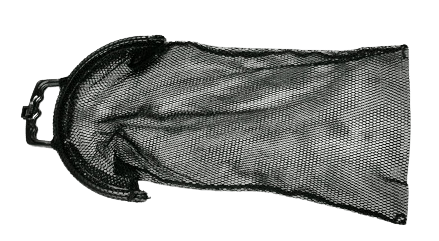
The nets
The nets allow the organizers of Initiatives Océanes to collect trash from the ocean floor.
If you are collecting samples underwater, please send an email to retrace@surfrider.eu to request that the nets be included in the kit.
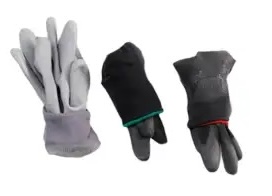
Gloves
We are sending you protective gloves for waste collection. Before wrapping up your beach, lake, river, or seabed cleanup, be sure to collect them so you can reuse them.
the organizer's guide
The “Organizer’s Guide” will help you prepare to oversee your cleanup. It contains all the information you need to successfully carry out your collection on a beach, a lake, along a riverbank, or on the seabed, and to learn more about aquatic waste.
To complement this kit, a wide range of practical and educational resources
are also available in the personal account area:
, including posters, an “organizer’s guide”
, and training videos to help you prepare for the collection!
Discover Ocean Campus
Ocean Campus is a real gold mine for teachers who want to raise their students' awareness of ocean protection!
Created by Surfrider Foundation Europe, this free platform is accessible to all and offers rich educational modules on essential topics such as plastic pollution, water quality, climate change, threats to marine ecosystems, and more.
What makes it so powerful? Creative and highly engaging content, sometimes featuring characters beloved by children—Titeuf, SpongeBob SquarePants, and many others—to address these issues in a fun and memorable way. With its interactive and adaptable courses, Ocean Campus is an essential tool for raising awareness among young people and encouraging them to adopt eco-friendly behaviors.